Broken Garage Door Spring Repair in Rockville, MD
A broken spring turns an ordinary garage door into a heavy, unpredictable object. Call at any hour and a technician will replace the spring, check the full counterbalance system and give you the price before the work.
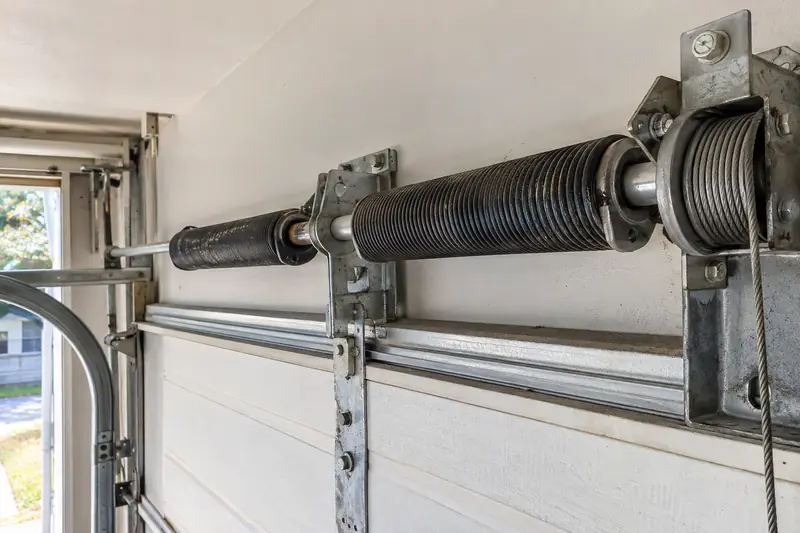
How garage door springs work
The opener is not meant to lift the full weight of the door. Springs counterbalance that weight so the door moves in a controlled way, and the opener only guides it. When the counterbalance fails, the motor strains, the door rises only a few inches, or one side lifts unevenly.
Most sectional doors use torsion springs mounted on a shaft above the opening, turning drums that wind the lift cables. Older and lighter doors may use extension springs along the horizontal tracks. Both store substantial energy. The number, size and configuration of the springs are matched to the door's actual weight and geometry; a spring chosen by appearance leaves the door too heavy or too eager to rise.
When you call, say whether the door is fully closed, partly open or stuck overhead, whether a car is inside, and whether you can see a gap in a spring or a loose cable from a safe spot.
Signs of a broken garage door spring
- A sudden loud bang Often on a cold morning. Look from a safe place for a gap in the spring; do not stand under the door.
- The door lifts only a few inches The opener senses too much weight, pauses and reverses.
- The door feels unusually heavy It has lost counterbalance. Do not test it by lifting a panel.
- One side rises faster than the other A cable, drum or spring problem that can twist the door out of the track.
- A cable is hanging loose It lost tension when the spring broke, or came off its drum.
- The opener runs but the door stays put A broken spring can look exactly like an opener failure.
If the door hangs, has left a track or is partly open with loose hardware, keep everyone out of the opening. A stationary door can still shift.
Why springs break in Rockville winters
Springs are rated in cycles, one open and one close. A standard spring is commonly built for about ten thousand cycles, and a household that uses the garage every day reaches that in several years. Cold does not create the wear, but it is when a worn spring tends to finally let go, which is why spring calls rise on freezing Rockville mornings. Salted slush tracked in on cars also rusts springs and shortens their life.
Torsion and extension springs
| Spring type | Where it sits | What to know |
|---|---|---|
| Torsion | On a shaft above the door | Works with cable drums; most two-car doors use two |
| Extension | Along the horizontal tracks | Older and lighter doors; must have safety cables |
| Higher-cycle | Either type, heavier wire | Worth it for doors used many times a day, if correctly sized |
For a torsion spring, the door's weight and height, the drum design, wire size, length, inside diameter and wind direction all affect the correct replacement. For extension springs, the spring rate, track layout, pulleys and containment cables matter.
When one spring in a two-spring system breaks, ask about the condition of the other. Both have done the same cycles, so replacing the pair is often recommended; the technician should explain why for your door and how the final balance will be confirmed.
Cables, drums and tracks
The spring supplies the force, but the cables and drums deliver it to the bottom of the door, and the tracks guide the rollers. If a cable slips off a drum, the door lifts unevenly. If a spring breaks, a cable can go slack even though the cable itself is fine. If a roller binds, the door strains against sound springs.
A careful inspection covers the cables for wear or kinks, the drums for correct winding and attachment, the bottom brackets, the spring supports, rollers and hinges, and the alignment of the door. It also confirms that the opener was not damaged by running an unbalanced door.
Never treat a loose cable as a string to pull tight. It is part of the counterbalance assembly and can move suddenly.
What a spring repair visit includes
- 01
Confirm the setup
Door type, spring arrangement, visible damage and whether the door is in a safe position.
- 02
Inspect related hardware
Cables, drums, tracks, rollers, hinges and the opener connection.
- 03
Present the repair
Which parts need replacing and why, with the price, before work starts.
- 04
Replace and balance
Springs matched to the door; the door should stay put halfway up.
- 05
Test and document
Smooth full cycles, the opener and safety devices tested, parts and warranty details on the invoice.
Make room for the technician to reach the inside of the garage if you can do so safely. Do not park under a hanging or partly open door. If a car is trapped, say so on the call. An old invoice or the door's model label can help identify parts, but the technician still checks the present condition.
Broken spring safety
Do
- Keep people, pets and vehicles away from a hanging or crooked door.
- Note the door's position and any trapped vehicle.
- Take a wide photo only from a safe place.
- Report a loose cable, a loud bang or a visible gap in the spring.
Do not
- Run the opener repeatedly against a heavy door.
- Pull a cable or loosen a bottom bracket.
- Wind, unwind or cut a spring.
- Stand under a partly open door to inspect it.
- Use a stronger opener to mask poor door balance.
A door with a failed spring can be far heavier than expected, and a partly open door can drop if released. Do not use the manual release to lift it without guidance.
Garage door spring repair questions
How can I tell whether the torsion spring is broken?
A visible gap in the coil above the door, a sudden bang and a door that becomes very heavy are the common clues. Look from a safe place and stop using the door.
Can I still use the opener with a broken spring?
It is best to stop. The opener is designed to move a balanced door, and repeated attempts can strain the motor or bend the top section.
Should both springs be replaced if only one broke?
Often, because both have done the same cycles. Ask the technician to explain the condition of the other spring.
What is the difference between torsion and extension springs?
Torsion springs sit on a shaft above the door; extension springs run along the horizontal tracks. Both store substantial energy.
Why did a cable come loose when the spring broke?
The spring, drum and cable are one system; losing tension lets the cable loosen or leave its drum. The cable is inspected before deciding what to replace.
Does a broken spring mean I need a new door?
Usually not. The spring is a separate repair if the rest of the door is sound.
How long does a spring repair take?
Usually about an hour or two once the correct springs are on hand, including balancing and testing.
Can I open the door manually to get my car out?
Do not try to lift or release it. Tell the person who answers that a car is trapped so it is part of the plan.
Do you cover my Rockville ZIP code?
20850, 20851, 20852 and 20853. Calls are answered at all hours; the visit is set for the next available window.
Talk it through with a person, any hour.
Call now(301) 000-0000Every day, at all hours (Eastern time). A person answers at any hour, asks what the door is doing, and sets up a visit with an independent local garage door technician who works Rockville.